Field note 003 · October 14, 2026
How to check a freeze-dried meat recall
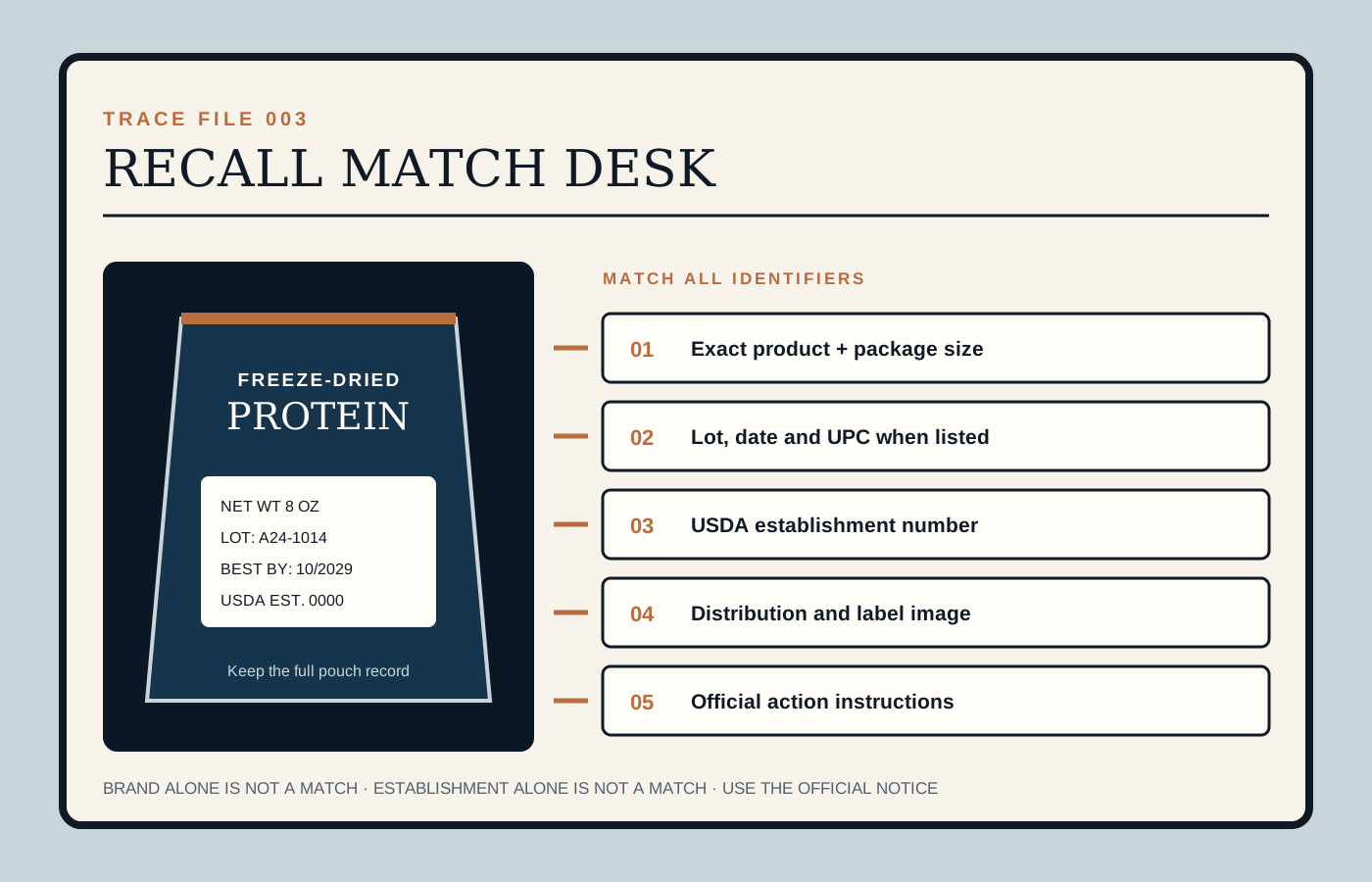
A brand name is a starting point. A reliable match uses the exact product, package size, lot or date code, USDA establishment number, label image, and instructions in the official notice.
Shelf-stable food is easy to forget once it is behind a pantry door. That makes traceability more valuable, not less. If a recall or public health alert appears months or years after purchase, the original pouch may be the only record connecting your food to the official notice.
Recent public discussions about meat recalls show a recurring problem: a headline names a brand, a shopper recognizes it, and the decision stops there. Some people discard every product from the brand. Others keep a package because its flavor or size was not in the headline. Neither shortcut is dependable. Official notices identify affected products with a combination of details, and the attached label images often resolve what a short summary cannot.
Do not taste food to investigate a recall. If the package could match, isolate it from food that will be used, keep the label readable, and consult the current USDA Food Safety and Inspection Service recall or public health alert. Follow the notice’s return, disposal, contact, and health instructions. When a product is regulated by another agency, follow that agency’s notice.
Build the package record before storage
Photograph all sides of the unopened package when it enters the pantry. Capture the exact product name, species and form, net weight, ingredient and allergen statements, preparation state, inspection mark, establishment number, lot or production code, date wording, UPC when present, storage directions, and manufacturer contact. Include enough context to show which number belongs to which package.
The record should remain available after the outer box is discarded or the contents are moved. For a large can or multi-pouch case, photograph the case label and each distinct inner label. Codes on a shipping carton may differ from the retail pouch. Do not assume one code substitutes for the other unless the official notice says so.
Keep the physical label with the food whenever practical. A typed inventory entry is helpful, but a transposed digit can make a recall match fail. The photograph preserves punctuation, prefixes, code placement, and label design. If you decant dry food, attach the complete original label and do not combine lots in one container.
Exact product
Brand, product name, species, cut or form, flavor, preparation state, and package size.
Codes
Lot, production or date code; best-by wording; UPC if listed; USDA establishment number.
Images
Front, back, inspection mark, code panel, storage directions, and the original package context.
Do not turn a best-by date into a lot number
Code formats vary. A best-by date, use-by date, lot code, production code, case code, and UPC answer different questions. Copy the label’s own wording and punctuation instead of guessing what a string means. If an official notice asks for a code your package does not clearly identify, compare its label PDF and contact the company or USDA Meat and Poultry Hotline.
Preserve the product’s preparation state
Record whether the label says ready-to-eat, cooked, not ready-to-eat, raw, or cook-before-eating. A recall notice can distinguish between products that look nearly identical but have different preparation states or labels. The preparation-state guide explains why “freeze-dried” does not answer this question by itself.
Read the USDA inspection mark and establishment number
FSIS explains that containers of USDA-inspected meat, poultry, and egg products carry a USDA mark of inspection and an establishment number assigned to the plant where the product was produced. For meat, the number generally appears with the prefix “EST.” Poultry plant numbers use “P-”. Egg products use their own plant identification conventions.
The establishment number can appear inside the inspection mark, elsewhere on the package, or off the exterior container when the label points to that location. Record the prefix as well as the digits. Similar-looking numbers elsewhere on the pouch may be a lot, UPC, nutrition reference, or customer-service code.
| Identifier | What it helps identify | What it does not prove alone |
|---|---|---|
| Brand name | The consumer-facing product family | The specific plant, lot, size, or affected code |
| USDA establishment number | The inspected producing establishment | That every product from the plant is recalled |
| Lot or production code | A defined production group when the maker or notice interprets it | Product identity without its label context |
| Date wording | A labeled production, use, freeze, or quality period | That a neighboring date is also included |
| UPC | A commercial product configuration | The lot or production run |
| Package size | The affected container format | The brand, plant, or code |
The plant is not necessarily the brand
The establishment number identifies the facility, while the front label may show a brand, retailer, distributor, or private-label name. One establishment may make products for more than one brand, and a company may use more than one establishment. That is why “same EST number” and “same brand” are both incomplete recall tests.
The FSIS Meat, Poultry and Egg Product Inspection Directory can help identify a federal establishment, but it is not a substitute for the recall notice. The directory describes establishments and activities; it does not prove that the specific pouch is affected or that a future sale is authorized. A seller also needs direct, current supplier documentation.
Match the official notice in a fixed order
- Start at the FSIS recall page. Search the official recalls and public health alerts, not a copied social post or retailer summary. Open the current notice and note any updates.
- Read the reason and action. Identify whether the issue involves contamination, an undeclared allergen, foreign material, misbranding, lack of inspection, or another reason. Do not use that reason to improvise a remedy.
- Match the exact product description. Compare brand, full product name, species, form, flavor, package type, and net weight. Small wording differences can matter.
- Open every attached label image. Compare layout, logos, inspection mark, code location, ingredient statement, and package size. A label PDF is part of the identification evidence.
- Match codes character by character. Compare lot, production, best-by, use-or-freeze-by, or case codes exactly as the notice defines them. Preserve leading zeros, prefixes, suffixes, and date format.
- Match the establishment number. Include EST., P-, or other stated prefix. Remember that the number supports a match but does not complete it alone.
- Review distribution information. A notice may name states, retailers, institutions, direct-to-consumer channels, or nationwide distribution. Distribution can expand as an investigation develops, so revisit the official page.
- Follow the official disposition. Use the return, disposal, contact, and medical instructions in the notice. Save a copy of the notice and record what happened to the package.
Use a two-column check sheet: “notice says” and “my package says.” Mark a field only when it is visible or confirmed. Write “not listed” when the notice does not use a particular identifier and “unresolved” when the package cannot be read. An unresolved field is a reason to seek official help, not permission to assume safety.
Recall, public health alert, and recall class are different fields
FSIS defines a recall as a firm’s action to remove a meat, poultry, or egg product from commerce when the agency determines that the product may be unsafe or mislabeled. FSIS also publishes public health alerts. These alerts can matter when affected food is no longer offered for sale but could remain in consumers’ storage, among other circumstances. Check both categories.
FSIS assigns recall classes based on relative health risk. Class I indicates a reasonable probability that use will cause serious adverse health consequences or death. Class II indicates a remote probability of adverse health consequences. Class III indicates that adverse health consequences are not expected or the risk is negligible. The class describes risk; it does not replace the product identifiers or action instructions.
“Active” and “closed” do not describe your pantry
A closed recall does not mean an affected package became acceptable to use. Status describes the agency’s recall process, not a reversal of the original problem. If an older package matches a notice, follow the notice and ask FSIS or the recalling company when disposition instructions need clarification.
What to do while the match is unresolved
Keep the product closed. Place it in a clearly marked secondary container away from food that will be prepared. Do not open it to inspect texture, smell it, rehydrate it, cook it to “fix” the concern, feed it to people or animals, or give it away. Prevent someone else from returning it to normal pantry rotation.
If the notice involves an undeclared allergen, do not rely on a household member’s past experience with the product. If it involves lack of inspection or possible contamination, cooking is not a consumer substitute for the notice’s instructions. If the package leaks, bulges, or is otherwise damaged, avoid unnecessary handling and follow official guidance.
When returning or discarding the product, retain the information needed for a refund, report, or follow-up before the label disappears. Photograph the package and code, record quantity and purchase source, and save any receipt or order history. Remove or deface labels when disposal instructions or local practice call for preventing retrieval, but follow the recall notice first.
One-pouch recall record
- Official notice URL and date checked
- Recall or alert number and current status
- Exact product and package size
- Lot, production, and date codes
- UPC when the notice uses it
- USDA establishment number with prefix
- Label-image match result
- Purchase source and approximate date
- Quantity isolated
- Company or USDA contact record
- Return or disposal action
- Date inventory was cleared
If someone ate the food
Read the notice’s health instructions and contact a health professional as directed, especially if symptoms or a serious allergen exposure are possible. Keep the package, label, lot information, receipt, and remaining product isolated unless authorities instruct otherwise. Report product problems through the channel named in the notice or the FSIS reporting system.
Build recall checks into pantry rotation
Set a routine check for official FSIS recalls and public health alerts, particularly before seasonal meal planning and before moving older packages into a ready-use kit. Subscribe to FSIS recall updates if that suits the household. A quarterly inventory can confirm that every protein package still has a readable trace record and current preparation instructions.
Organize by product type and date without hiding labels. Keep packages facing forward or use a simple index that points to a photograph. Do not write over codes. When splitting a case, copy the case record to each storage group and never merge lots. The goal is to answer “which exact package?” without opening every container.
Connect the trace record to practical planning. The package-yield worksheet keeps dry weight, serving size, added water, and prepared yield separate; add the recall-check date and label-photo path to the same card. A record that supports meal planning and recall matching is more likely to stay current.
A stronger standard for future listings
Freeze Dried Cuts remains a planning preview. Prices, checkout, inventory, branded listings, and availability are disabled until supplier authorization and accurate commercial terms are documented. No future listing should imply that the site is an authorized reseller until written permission exists.
Any future protein listing should show the exact manufacturer and product, package size, preparation state, ingredients and allergens, net dry weight, maker-stated yield, after-opening instructions, current label image, USDA establishment number when applicable, lot-code location, recall-check date, manufacturer contact, and authorized supply record. A general “USDA inspected” badge cannot substitute for the actual trace fields.
When a recall or alert affects a listed product, the listing should be disabled promptly, the exact codes preserved, the official notice linked, and availability claims removed until the responsible supplier and authorities resolve the disposition. Merchandising must never outrun traceability.
Frequently asked questions
Does a matching USDA establishment number prove my package is recalled?
No. An establishment number identifies a producing plant, not one specific product or lot. Compare every identifier listed in the official notice, including product name, package size, lot or date code, label image, and other stated details.
Can a freeze-dried meat product be recalled after years in storage?
A recall or public health alert can concern products that consumers may still have in storage. Keep the original label and lot information, review official notices, and follow the notice for the exact package.
Should I taste a package to decide whether it is affected?
No. Never taste food to evaluate a recall. Isolate the package, match its identifiers to the official notice, and follow the stated return, disposal, or contact instructions.
Sources
Reviewed October 14, 2026. Official notices and the current package label control each product decision.
- USDA FSIS — Recalls & Public Health Alerts
- USDA FSIS — Understanding FSIS Food Recalls
- USDA FSIS — How to Find the USDA Establishment Number on Food Packaging
- USDA FSIS — Meat, Poultry and Egg Product Inspection Directory
- USDA FSIS — Recall and Public Health Alert API
- USDA FSIS — Report a Problem with Food