Field note 002 · Package yield
How much protein is in the pouch?
Net dry weight, serving size, water added, and prepared yield answer different questions. Keep the four numbers separate before you compare packages or plan a meal.
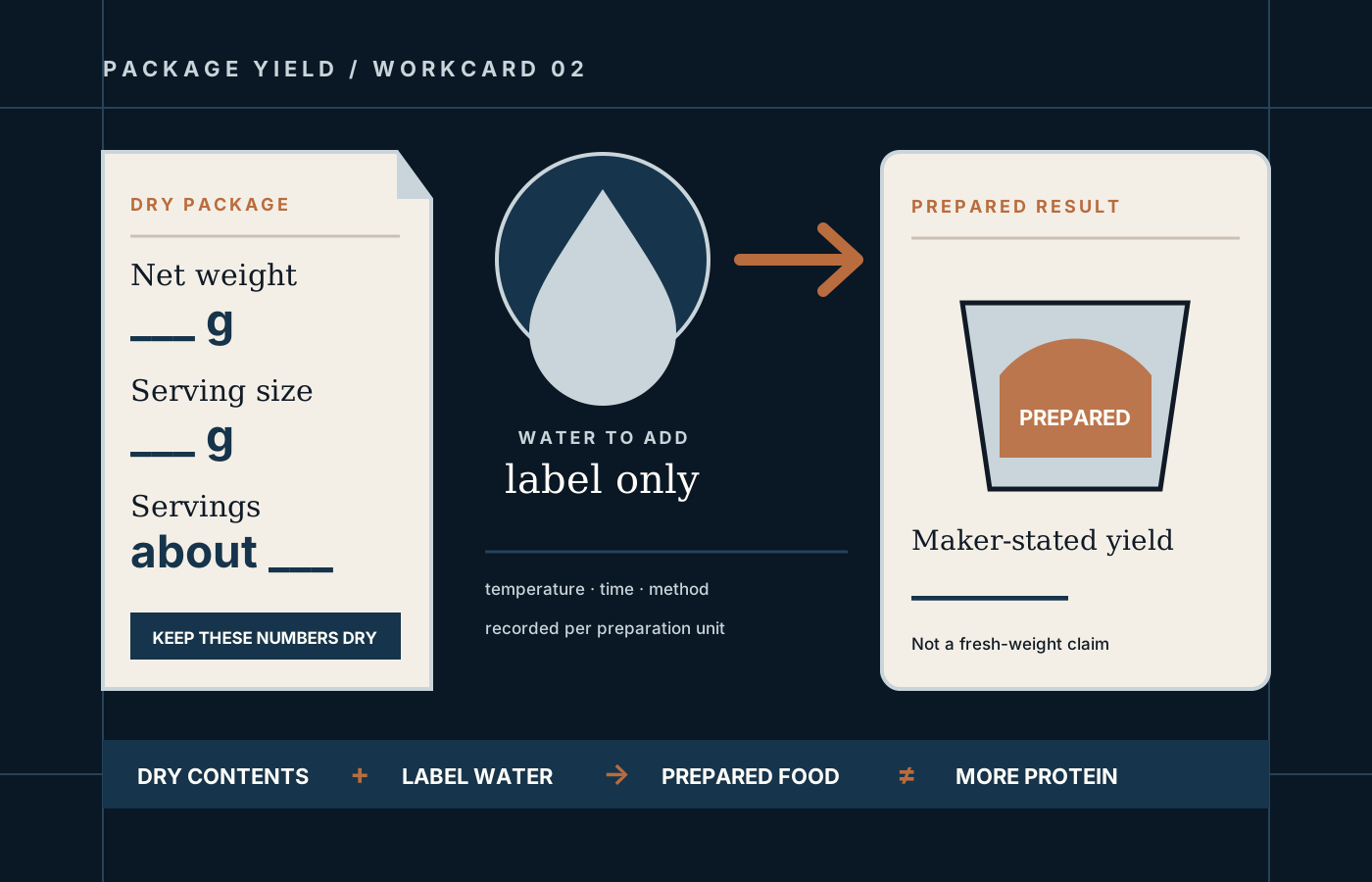
“How many pounds does this make?” sounds like a single question. A freeze-dried protein label may give several legitimate numbers, but none should be silently converted into a promise the label does not make.
One package might state a dry net weight, a serving size in grams, a number of servings, an amount of water for each serving, and a prepared volume. Another may provide only some of those fields. The first package is easier to plan with, but the extra numbers still describe different measurements. Adding water increases prepared mass and volume; it does not add protein, calories, or meat solids.
Recent public discussions show the recurring confusion. Readers try to convert a large can into “fresh pounds,” divide a water reserve by a generic cup-per-serving assumption, or treat the Nutrition Facts serving count as a household meal count. The sound response is label-specific: use the manufacturer’s current preparation directions and disclosed yield, then decide how that prepared food fits your own recipe.
Four numbers that must not be merged
Net dry weight
The amount of food in the unopened container, excluding the package. It describes contents before you add water.
Serving size
The labeled amount used to calculate the Nutrition Facts. FDA says serving size is not a recommendation of how much to eat.
Water to add
The manufacturer’s product-specific quantity and method for rehydrating a stated amount of dry food.
Prepared yield
The amount the maker says the package produces after preparation, when the label actually provides that claim.
Protein and calories
Nutrients per labeled serving. Multiply by servings consumed, not by the weight of added water.
Your meal allocation
The amount your recipe or household uses. This is a planning decision, not a new label claim.
FDA describes net quantity as the statement of how much food is in the container or package. For a solid food, it is generally expressed by weight. USDA FSIS guidance for meat and poultry labels likewise identifies the product name, net weight, ingredients, handling statement, inspection information, and Nutrition Facts among the label features that may apply.
The Nutrition Facts serving size has a different purpose. FDA explains that it is based on an amount customarily consumed and is not advice about how much a person should eat. “About 10 servings” therefore means roughly 10 labeled nutrition units. It does not prove 10 entrées, 10 complete meals, 10 adult portions, or 10 equal scoops after pieces settle in transit.
If a dry portion receives 100 grams of water, the prepared food may weigh roughly 100 grams more if all the water is retained. Its protein and calories do not increase. A prepared-weight comparison should never be presented as an equivalent fresh-meat weight unless the manufacturer supports that exact equivalence.
Build a comparison worksheet from the package
Photograph every panel before opening. A product name on the front is not enough. Capture the net quantity, ingredient list, Nutrition Facts, lot or date code, preparation directions, cooking or ready-to-eat statement, after-opening storage directions, inspection mark when applicable, and manufacturer contact.
| Field | Copy exactly | What it can support |
|---|---|---|
| Product identity | Species, cut or form, cooked/raw/RTE wording | A like-for-like comparison and the correct safety path |
| Net quantity | Dry package weight and unit | Dry food received; price-per-dry-ounce only when price is authorized |
| Serving size | Household measure and grams | Nutrition calculations using the label |
| Servings per container | Exact or “about” count | Approximate number of Nutrition Facts units |
| Preparation ratio | Dry amount, water amount, temperature, time, method | Label-specific water planning and repeatable preparation |
| Prepared yield | Only the stated weight, volume, or count | Prepared-package comparison in the same unit |
| After-opening directions | Container, temperature, time, moisture controls | Batch sizing and safe storage workflow |
| Lot record | Lot, best-by/use-by, establishment or maker | Traceability, recall checks, and support questions |
Do not fill a blank field with a competitor’s number or an internet rule of thumb. A diced cooked chicken, an uncooked beef crumble, and a seasoned shredded pork can differ in density, fat, particle size, ingredients, preparation state, and water uptake. Even two products with the same species and dry weight may prepare differently.
If the label gives a range, preserve the range. If it says “about” or “approximately,” keep that qualifier in your notes. Rounding an approximate serving count into an exact household promise creates false precision.
Plan water from directions, not from servings alone
A water budget needs the preparation instruction for the exact product and the exact amount you plan to prepare. Do not multiply a generic cup of water by every serving across a pantry. Piece size, prior cooking, formulation, and desired use change how much water is called for.
- Choose the preparation unit. Use one labeled serving, a stated pouch, or another quantity the manufacturer defines.
- Copy the directed water amount. Keep volume and mass units as printed. Do not silently interchange fluid ounces and ounces by weight.
- Multiply by the number of units you will actually prepare. Keep a separate subtotal for each product.
- Add process water only when needed. Include water for boiling, warming, rinsing, or cleanup when your method requires it, but label that amount separately from water absorbed by food.
- Test one current package. Record absorption, leftover liquid, texture, time, temperature, and the prepared amount you can actually use.
The simplest pantry worksheet has one row per SKU and lot. It records dry units, water per unit, units planned, total rehydration water, and a separate operational-water allowance. When a label or formulation changes, start a new row.
Water temperature and time are instructions, not decorative suggestions. Hot water may be used for a ready-to-eat product’s quality, while a cook-before-eating product needs a full cooking process and safe final temperature. Our preparation-state guide explains why freeze-dried does not automatically mean ready to eat.
Translate label units into a recipe, not a marketing claim
Start with the recipe role. Protein used as a soup garnish is different from protein used as the main component. Decide the edible amount needed for the recipe, then test how much of the specific prepared product supplies that role. Record the result as your kitchen allocation.
For nutrition planning, use the label. If you consume two labeled servings, multiply the per-serving calories, protein, sodium, fat, and other relevant nutrients by two. Added plain water does not change those totals. Broth, sauce, oil, or other additions do and should be counted separately.
For inventory planning, keep three columns: unopened containers, dry weight remaining after opening, and tested meal allocations. Do not subtract a guessed “fresh equivalent” from the pantry. Count what you own in the units the label and your scale can verify.
Package-level math can reveal useful limits. A pouch with more servings is not necessarily more protein if the serving is smaller. A heavier package may contain seasonings, sauce ingredients, or fat in addition to meat. A high prepared volume may reflect more water. Compare nutrient totals, ingredient identity, preparation state, dry quantity, and manufacturer-stated yield side by side.
Use a scale without inventing accuracy
A kitchen scale can divide an open package more consistently than counting irregular pieces. Tare the empty container, weigh the dry food, and use the label’s gram serving as the starting unit. Settling can make cup measures inconsistent, especially when a package contains a mix of powder, small fragments, and larger pieces.
Dividing by weight does not prove every scoop has identical nutrition. The label describes the product under its labeling rules, while individual portions may contain different proportions of pieces and fines. Mix only when the manufacturer directs it and when doing so does not conflict with safe handling.
If you test prepared yield, weigh the empty bowl, dry portion, water added, prepared bowl, and any liquid drained. Record the numbers as a kitchen test of that product and lot. Do not publish the result as a universal conversion or override the labeled method.
Reject five shortcuts
“One serving equals one meal.”
Serving size is a Nutrition Facts unit based on customary consumption, not a personalized meal prescription. Compare calories and protein against the complete meal you are planning.
“Dry ounces convert directly to fresh pounds.”
Freeze drying removes water, but products also differ in cut, cooking loss, fat, connective tissue, formulation, and final moisture. Use a manufacturer-supported equivalence or state only the measured dry and prepared amounts.
“Water plus dry weight equals guaranteed edible yield.”
Some water may remain in the vessel, evaporate, or be drained. The arithmetic is a mass-balance estimate only when every input and remainder is measured.
“All freeze-dried meat uses the same water ratio.”
There is no dependable universal ratio across cuts and forms. Use the current package directions and verify a sample.
“A sealed pouch settles the safety question.”
Packaging does not tell you whether the product is ready to eat. Read the preparation state and safe-handling instructions. USDA’s safe-handling label directs consumers of applicable raw or not-ready-to-eat meat and poultry to prevent cross-contamination, cook thoroughly, and refrigerate leftovers promptly.
Opening the package changes the planning problem
A long unopened shelf-life claim is not automatically an after-opening claim. Once opened, moisture, oxygen, handling, and repeated access can affect the food. Copy and follow the maker’s exact after-opening instructions and time limit. Do not extend them because the food still feels dry or because an oxygen absorber remains in the container.
If the package is larger than your tested use rate, that is a purchasing-fit issue. Choose a smaller package or a product with after-opening directions that match the household. Repackaging into household containers does not preserve the original manufacturer’s shelf-life claim unless the maker explicitly supports that method.
After rehydration, the food no longer has the same low-moisture condition. Follow the label’s holding and refrigeration directions, prevent cross-contamination, and use current USDA/FDA guidance for cooked or raw meat and poultry as applicable. Do not leave a rehydrated protein at room temperature based on its former dry state.
Keep a one-package record card
- Brand and exact product name
- Species, cut, and form
- Cooked, RTE, or cook-first status
- Dry net weight
- Serving size in grams
- Servings per container
- Calories and protein per serving
- Water and method per unit
- Stated prepared yield
- After-opening instructions
- Lot and date code
- Recall and support contact
After a test preparation, add the date, actual dry amount, water used, time, method, prepared amount, leftover liquid, texture, meal role, and number of household allocations. That record is more useful than a generic conversion chart because it stays attached to the specific product.
Freeze Dried Cuts will publish dry weight, preparation state, ingredient list, label-directed water, maker-stated yield, and after-opening directions as separate fields. Prices, branded listings, checkout, inventory, and availability remain disabled until supplier authorization and current commercial terms are documented.
Sources
- USDA FSIS: Check List for Mandatory Features on a Label
- USDA FSIS: Safe Handling Label Text
- USDA FSIS: Meat and Poultry Labeling Terms
- FDA: Serving Size on the Nutrition Facts Label
- FDA: Food Labeling Guide
Research reviewed October 7, 2026. Read and retain the current label and manufacturer instructions for the exact product and lot.