Field note 005 · Open-package desk
Freeze-dried meat after opening
The long shelf-life claim belongs to a sealed package. Once the seal breaks, copy the maker's shorter window, control moisture, and start a separate clock when water is added.
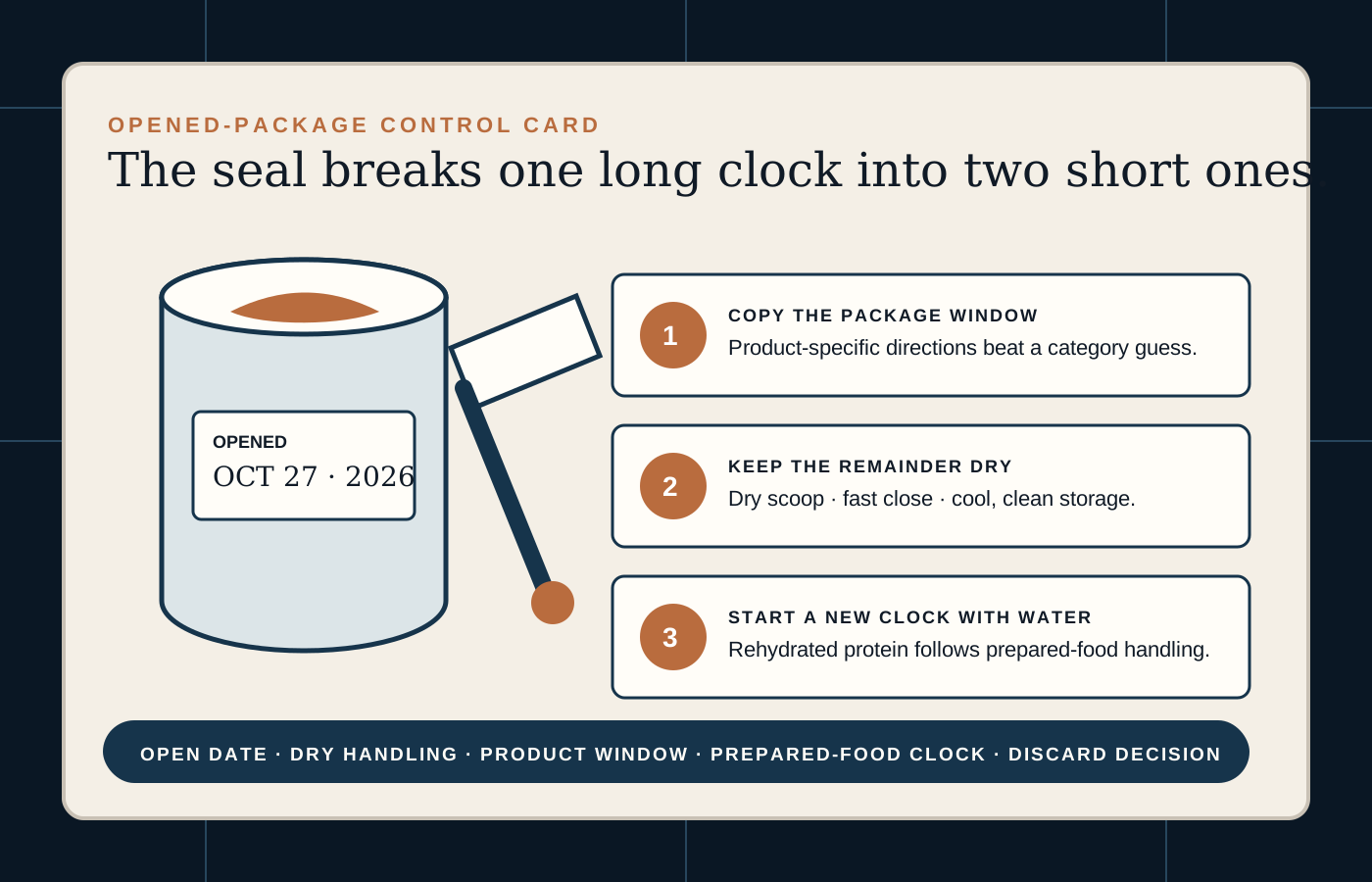
How long does freeze-dried meat last after opening? The reliable answer is the after-opening instruction for the exact product—not the 20- or 30-year statement on the front of the can and not a rule copied from another brand.
That distinction is easy to miss because one package can carry several time statements. The maker may publish a long unopened shelf life, a much shorter period for dry contents after opening, and separate directions for food after it is rehydrated. Each statement assumes different packaging and handling conditions.
Current official manufacturer guidance shows why a universal number is misleading. Mountain House recommends using opened dry contents within one week for best results and taste. Augason Farms says to use opened food within one year while keeping it tightly sealed in a cool, dry place, with product-specific directions taking priority. Those are not interchangeable promises. They apply to those manufacturers' products, packages, and stated conditions.
Before opening, photograph the full label and copy the product name, lot or date code, USDA establishment number where present, unopened storage statement, after-opening direction, preparation state, and manufacturer contact. If the after-opening instruction is missing or unclear, contact the maker before planning extended storage.
Separate the three storage clocks
Clock 1: unopened shelf life
An unopened shelf-life claim assumes that the original package remains intact and the product stays within the manufacturer's storage conditions. USDA FSIS defines shelf stability for dried meat and poultry around the product remaining safe and unspoiled through the manufacturer-specified shelf life while package integrity is maintained during storage, shipping, display, and use in the home.
The sealed can or pouch, its closure, the food's validated process, its water activity, and the maker's testing form one system. A best-by or guaranteed shelf-life statement is not a property of the meat alone. It cannot simply follow the contents into a household container after the original barrier is opened.
Clock 2: opened but still dry
Opening admits room air and makes handling part of the storage system. FDA's preventive-controls draft guidance for dried foods says packaging should prevent rehydration under expected storage and distribution conditions and closures should be free of defects that expose food to moisture. In a home kitchen, that means the lid, scoop, humidity, steam, spills, storage temperature, and frequency of opening now matter.
The maker's after-opening statement remains the controlling time guide. Write the opening date on the container and calculate the maker's stated end date. If the label says “refrigerate after opening,” that direction controls even though the food looked shelf stable before opening.
Clock 3: rehydrated or incorporated into a meal
Water addition ends the dry-product assumption. Rehydrated protein should be handled as prepared perishable food under the exact package method and current food-safety guidance. Do not return a damp scoop or unused rehydrated pieces to the dry container. For a practical one-portion method, use the rehydration bench guide.
Why after-opening windows differ
The same category name can hide meaningful differences: cooked or raw state, fat content, ingredients, piece size, residual water activity, oxygen level, package barrier, closure design, fill size, and the manufacturer's validated conditions. A #10 can of cooked diced chicken is not automatically comparable to a pouch of raw freeze-dried steak, a complete meal, or a home freeze-dried product.
USDA warns that removing oxygen does not make perishable meat safe at room temperature. Vacuum packaging can help the storage quality of foods that are already dry and nonperishable, but reduced oxygen is not a substitute for the product's validated shelf stability, label, or refrigeration direction.
Public discussions repeatedly ask whether an airtight jar, vacuum sealer, or fresh oxygen absorber can “restart” the 30-year clock. That question reveals a real planning gap, but anecdotes cannot establish a safe or guaranteed shelf life. A household transfer changes the packaging system without recreating the maker's process controls, seal verification, barrier testing, lot traceability, or shelf-life study.
Use a dry open-package workflow
- Read before opening. Confirm the exact product, preparation state, unopened date language, storage conditions, after-opening period, refrigeration statement, oxygen-absorber direction, lot code, and maker contact.
- Choose the right can for the plan. Compare the package's dry contents with meals you can realistically make inside its after-opening window. Smaller packages may reduce waste for small households.
- Prepare a clean, dry work area. Keep the container away from a steaming pot, sink spray, wet utensils, raw-food work, pets, pests, and condensation. Wash and dry hands as appropriate for the product directions.
- Remove one measured portion. Use a clean, completely dry scoop. Keep the package open only as long as needed. Record dry amount, water, prepared yield, and recipe allocation separately.
- Follow the absorber instruction. The packet is not food. Some makers direct customers to remove and discard it. Do not assume an old packet remains active or a new packet restores the factory shelf life.
- Close and store exactly as directed. Seat the supplied lid or closure fully. Use the maker's cool, dry, sanitary storage range and any after-opening refrigeration instruction. Do not store near heat, humidity, chemicals, or flood risk.
- Mark the control dates. Write the date and time opened, the maker's use-within date, and any shorter limit on the label. Keep the original label with the container.
- Start a new record when water is added. Follow the labeled rehydration or cooking method, prevent cross-contamination, refrigerate prepared leftovers promptly when applicable, and never mix damp food back into dry contents.
Compare instructions without blending them
| Source | Dry contents after opening | Handling notes | What the example proves |
|---|---|---|---|
| Mountain House FAQ | Use within one week for best results and taste | Dry, sanitary storage; avoid package damage and prolonged extreme heat; rehydrated food is treated like fresh food | A very long unopened guarantee can become a short opened window |
| Augason Farms FAQ | Use within one year | Keep cool and dry; individual product directions take priority; the maker's opened-package guide says to remove and discard the original oxygen absorber | Another maker's period can be much longer without becoming a category rule |
The useful comparison field is therefore not “freeze-dried meat lasts X after opening.” It is “this exact product, in this package, has this maker-stated after-opening period under these conditions.” Preserve that wording in a pantry record.
Repacking does not recreate the factory claim
If a manufacturer gives instructions for transferring or resealing its product, follow those instructions exactly. Otherwise, do not invent a new long-term date because food was moved to a jar, zipper bag, vacuum bag, or foil pouch. Utah State University Extension advises packing dried foods in amounts that can be used after opening and notes that oxygen absorbers can help quality in suitable packages, but package choice and absorber use do not establish a manufacturer-validated shelf life for commercial freeze-dried meat.
Household vacuum sealers also differ in bag barrier, seal quality, and intended use. A bag that appears tight can still lack the moisture and oxygen performance of the original package. Reopening it repeatedly changes conditions again. If you choose to portion food for near-term convenience, keep the original product identity, lot, directions, opening date, and shortest applicable use period with every portion. Do not resell or donate a relabeled household portion as an unopened commercial product.
Do not place an oxygen absorber into food casually. Absorber type and capacity, product moisture, headspace, package barrier, and seal all matter. The packet must stay intact and away from children and anyone who could mistake it for food. Product and absorber manufacturers—not an online rule of thumb—must support the intended use.
Use a stop rule, not a taste test
Discard the product when the maker's after-opening period has passed, required storage was not maintained, identity or opening date is unknown, or the package direction says to discard. Also stop if there is evidence of water exposure, a failed closure, pests, leakage, swelling, corrosion, unusual clumping or softening, unexpected odor or appearance, or a recall match.
Do not taste food to decide whether a compromised package is safe. Do not try to dry damp commercial product again and assign it a new shelf life. If the package may match a recall, use the product name, package size, lot or date code, label image, distribution, and USDA establishment number with the recall match guide.
A dent or puncture should be evaluated against the package maker's instructions. A compromised barrier can matter even when the contents still look dry. Contact the manufacturer with clear photographs and the lot information; do not transfer food and assume the damage no longer matters.
Build an open-package record
Copy, date, control
- Brand and exact product name
- Species, cut or form, and preparation state
- Lot/date code and USDA establishment number
- Unopened date wording and storage conditions
- Maker's after-opening window
- Refrigerate-after-opening language, if any
- Oxygen-absorber instruction
- Date and time opened
- Calculated use-within date
- Dry portions removed
- Water and prepared yield for each test
- Container or closure observation
Pair this record with the package-yield worksheet. If a large can contains more portions than the household can use within the stated window, that is a package-fit problem to discover before purchase, not after an emergency opening.
Questions at the open-package desk
Can I use the unopened best-by date after opening?
No. The unopened statement assumes the original seal and specified conditions. Use the product's after-opening instruction and date the package when the seal is broken.
Can a new oxygen absorber restore the long shelf life?
Do not assume so. It cannot recreate the manufacturer's process, original atmosphere, verified seal, package-barrier performance, or shelf-life study. Use an absorber only when the product and absorber instructions support it.
Should I refrigerate dry contents after opening?
Follow the exact package. Refrigeration may be required for some products and unnecessary or unsuitable for others; condensation and repeated temperature changes can also introduce moisture. Do not substitute a generic answer for the label.
What if the maker publishes a different window online?
Check that the guidance applies to the exact product and package, note the review date, and contact the manufacturer when the label and current documentation conflict. Keep the response with the pantry record.
A listing standard for opened-package claims
Freeze Dried Cuts will keep unopened shelf life, after-opening storage, oxygen-absorber direction, preparation state, and prepared-food handling as separate fields. A future listing cannot turn one maker's one-week or one-year statement into a sitewide promise. Branded products, prices, inventory, availability, sellers, and checkout remain disabled until supplier authorization, current labels, accurate commercial terms, fulfillment, returns, and warranties are documented.
Sources
Reviewed October 27, 2026. Package directions and current manufacturer documentation control the exact product.
- USDA FSIS — Ready-to-Eat Fermented, Salt-Cured, and Dried Products Guideline.
- FDA — Draft Guidance for Industry: Hazard Analysis and Risk-Based Preventive Controls for Human Food, Chapter 9 discussion of dried foods and moisture-protective packaging.
- USDA FSIS — Can I keep meat in vacuum packages at room temperature?
- Mountain House — Frequently Asked Questions.
- Augason Farms — Frequently Asked Questions.
- Augason Farms — Freeze-Dried Food Shelf Life After Opening.
- Utah State University Extension — Packaging Foods.
Public discussions were evaluated to identify recurring questions about one-week versus one-year claims, oxygen absorbers, repacking, humidity, large #10 cans, and whether a household seal restores the original shelf life. Operational guidance above comes from the cited primary and Extension sources.