Field note 004 · Rehydration bench
How to rehydrate freeze-dried meat without guessing
Copy the package method, test one measured portion, record the result, and treat added water as the start of a new handling and storage clock.
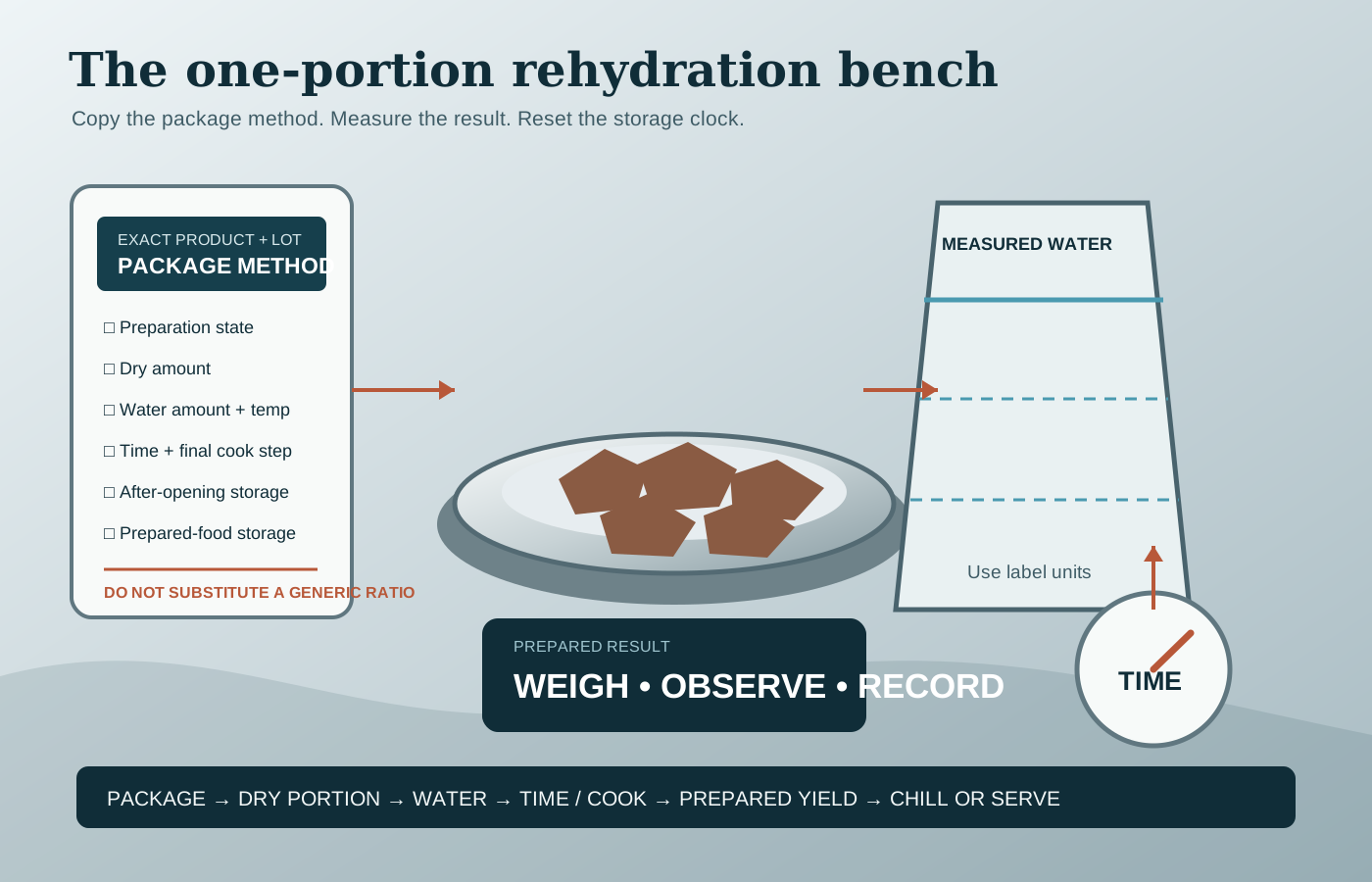
The safest useful answer to “How do I rehydrate freeze-dried meat?” begins with a label, not a universal ratio.
Freeze-dried beef cubes, chicken dice, pork bites, crumbles, strips, and shredded meat do not share one absorption rate. Piece dimensions, fat, connective tissue, prior cooking, seasonings, sauces, drying endpoint, packaging, and intended recipe all change the result. One maker may direct a measured hot-water soak. Another may direct simmering. A cook-before-eating product may require a complete cooking step after water is added. “Just add water” is incomplete unless the package defines the amount, temperature, time, method, preparation state, and storage after preparation.
This distinction has unusually timely support. The FDA’s newly issued 2026 Food Code added section 3-501.10 for commercially packaged dehydrated food. FDA’s summary says the section addresses following manufacturer rehydration instructions for food dehydrated in a processing plant. The Food Code is a model for retail and food-service regulation, rather than a household recipe book, but the practical principle travels well: the validated package method belongs at the center of the process.
Freeze-drying removes water; it does not reliably kill bacteria. Utah State University Extension explains that bacteria can survive freeze-drying and become active again when water is added. First determine whether the product is ready-to-eat or requires cooking, then follow the current package instructions for the exact product and lot.
1. Copy the complete method before opening
Photograph every package panel. Record the exact product name, species, cut or form, ingredients and allergens, dry net weight, serving size, preparation-state language, water amount, water temperature, rest or simmer time, final cooking step, after-opening storage, prepared-food storage, lot or date code, manufacturer contact, and USDA inspection mark or establishment number when applicable.
Do not reduce the instruction to a single water ratio. “One cup water” is meaningless without the dry amount it belongs to. “Soak 10 minutes” is incomplete without water temperature and whether liquid is drained, retained, or used in a final cook. Preserve every unit and qualifier. Fluid ounces measure volume; ounces on a scale measure mass. Cups, grams, pouch counts, and servings are not interchangeable without supported conversion.
| Field | Copy exactly | Why it matters |
|---|---|---|
| Product identity | Species, cut or form, flavor, cooked/raw/RTE wording | Selects the safety and preparation path |
| Dry unit | Grams, ounces, cups, serving, pouch, or other stated amount | Defines what the water instruction applies to |
| Water | Amount, temperature, and source requirement | Controls absorption and method; potable water is essential |
| Time and vessel | Covered or uncovered, soak or simmer, stated minutes | Affects heat retention, hydration, and final texture |
| Final step | Drain, stir, rest, boil, simmer, or cook to temperature | May be necessary for safety, not merely texture |
| Storage | Unopened, opened-dry, rehydrated, and leftover directions | Separates three different storage conditions |
If any safety-relevant direction is missing or ambiguous, stop and ask the manufacturer. Do not fill the gap with another brand’s directions, a social-media shortcut, or a ratio copied from a different cut. Record the response with the product and lot.
Check the package before the food
A puncture, failed seal, swelling, leakage, moisture inside a package expected to be dry, unreadable identity, or uncertain storage history needs manufacturer or official guidance. Do not taste a piece to investigate. Check the exact package against current USDA FSIS recalls and public health alerts using the method in our recall match guide.
2. Run one measured portion before planning a meal
A one-portion test answers practical questions while keeping waste small. It is not an attempt to rewrite the label. Use the maker-defined portion or another quantity that can be scaled from the printed instructions without rounding away precision.
- Prepare a clean station. Wash hands and use clean utensils, vessel, measuring tools, scale, thermometer, landing area, and potable water. Separate a raw or not-ready-to-eat product from ready-to-eat food.
- Weigh the empty vessel. Record its tare weight if you will measure the prepared result. A stable, heat-safe vessel should match the package method.
- Measure the dry food. Use the label unit. If pieces and fines have separated, follow maker directions about mixing rather than choosing only large pieces.
- Measure the water. Use the exact amount and temperature stated for that dry portion. Do not estimate by eye.
- Follow the time and method. Cover, stir, rest, simmer, drain, or retain liquid exactly as directed. Start timing at the point the label specifies.
- Complete any cooking step. Rehydration does not replace cooking. Use a food thermometer when the label or food-safety path requires one.
- Measure the result. Record prepared weight or volume in the same way each time, plus remaining liquid, texture, and intended recipe role.
- Serve, hold, or chill promptly. Apply the package storage instructions and current guidance for perishable prepared food.
Keep the dry weight, water added, prepared weight, drained liquid, and food consumed as separate fields. Added water can increase mass and volume, but it adds no protein or calories. Our package-yield worksheet explains why dry net weight, Nutrition Facts serving size, water, and prepared yield cannot be collapsed into one “fresh equivalent.”
Use potable water and a controlled container
FDA’s Food Code defines drinking water as potable water. At home, use water known to be safe. During an emergency, a shelf-stable pouch does not make an uncertain water source safe. Follow local public-health instructions for drinking water and the product maker’s temperature requirement.
The vessel should tolerate the stated water temperature and any required heating. Leave safe room for stirring and expansion. A lid can change heat retention, so cover only as directed. When heating in a microwave, use a microwave-safe vessel and follow both the food and appliance instructions; stir and check multiple points when a final temperature is required because cold spots can remain.
3. Rehydration and cooking are different steps
Freeze-dried describes a drying process. It does not establish that food is ready-to-eat. Our preparation-state guide separates three paths:
Ready-to-eat
Rehydrate or warm as the package directs for quality. Protect the product and prepared food from cross-contamination.
Cooked + directions
Complete the package’s stated preparation. “Cooked” does not automatically mean every final step is optional.
Cook before eating
Handle as not-ready-to-eat, prevent cross-contamination, cook by the labeled method, and verify the appropriate safe internal temperature.
Utah State University Extension notes that freeze-drying can preserve bacteria and that rehydrated foods need an appropriate kill step unless they are ready-to-eat. The agency’s consumer guidance advises cooking meats and eggs before freeze-drying or after rehydration. For a commercial package, do not invent the step: follow its preparation-state statement and manufacturer directions.
USDA’s current consumer temperature table gives 145°F with a three-minute rest for whole cuts of beef, pork, veal, and lamb; 160°F for ground meats; and 165°F for poultry, casseroles, and leftovers. The product’s species and form determine which line applies. Small freeze-dried pieces can be difficult to probe, so use a thermometer suited to thin foods and follow its sensing-area instructions. When the cut or form is unclear, ask the maker.
Never use the temperature of the water as a substitute for the internal temperature of food that must be cooked. A hot soak may cool rapidly, and small pieces may heat unevenly. Color, softness, steam, and elapsed time do not prove that the required finished temperature was reached.
Do not rinse raw poultry or spread its liquid
USDA advises against rinsing or soaking raw poultry because splashing can spread bacteria to surfaces and other food; only cooking destroys bacteria that may be present. If a product is raw or not-ready-to-eat and the package calls for water, contain that water inside the directed cooking process. Do not drain it into a sink full of dishes or reuse it outside the validated method.
4. Adjust texture inside the package method
A bench test may end with firm centers, soft edges, loose fragments, or extra liquid. First check whether the correct dry amount, water, temperature, time, covering, and stirring method were used. A scale or timer error is more likely than proof that the printed method is wrong.
If the package provides a range, begin within it and record the exact point used. If it allows additional water, add only in the increment and stage it specifies. A little water added to the bowl, a longer rest, and simmering in a soup can produce different results. Keep quality adjustments distinct from safety steps. Never shorten a cook-before-eating method because the texture seems ready.
| Observation | Check first | Do not assume |
|---|---|---|
| Dry or firm center | Piece size, water amount and temperature, cover, time, final cook | That all future batches need an arbitrary extra cup |
| Mushy edges | Overmeasurement, time, agitation, fines, piece consistency | That draining reverses the change or makes unsafe food safe |
| Liquid remains | Whether the label says drain, retain, or cook it into the recipe | That it is broth safe for another use |
| Uneven result | Mixed piece sizes, settling, crowding, stirring instruction | That selecting only large pieces represents the package |
| Unexpected odor or appearance | Package condition, lot, directions, maker and recall record | That tasting is a safe diagnostic |
For recipe building, decide whether the protein should be rehydrated separately, simmered in the dish, or added at another stage only from the maker’s supported options. Salt, acid, fat, starch, and competing ingredients can affect texture and water availability. A ratio that works in plain water may not translate to a thick sauce. Keep the package method and recipe test together.
5. Adding water starts a new storage clock
A long unopened shelf-life claim belongs to a sealed, low-moisture package under stated conditions. Opening changes exposure to moisture and oxygen. Rehydrating changes the food more dramatically. Do not return prepared meat to dry storage or assume its former shelf stability continues.
Follow any shorter, product-specific storage limit. In the absence of a shorter instruction, USDA’s general consumer guidance says to refrigerate perishable food within two hours, or within one hour when the temperature is above 90°F; keep the refrigerator at 40°F or below; use most cooked leftovers within three to four days; and reheat leftovers to 165°F. Divide large amounts into shallow containers for rapid cooling. These are general guardrails, not permission to override the package.
If refrigeration is unavailable, prepare only the amount that can be safely cooked and eaten within the directed period. Do not make a large batch simply because the dry package is large. A smaller package or individually sealed portions may better fit the household’s real use. Package size is therefore part of food-safety and waste planning, not just value comparison.
Track opened-dry food separately
After opening, follow the maker’s exact directions for resealing, time, temperature, humidity protection, and oxygen absorber handling. Do not extend an after-opening period because pieces still feel crisp. Avoid repeatedly opening the main container in a steamy kitchen. If the maker supports portioning, use its specified containers and procedure; otherwise, repackaging does not inherit the original unopened shelf-life claim.
Keep allergens in the record. Seasoned meats can contain milk, soy, wheat, sesame, or other ingredients. A shared rehydration vessel, strainer, measuring cup, or storage container can transfer residues. Use the ingredient and allergen statement for the exact lot and maintain the household’s allergen controls.
6. Keep a one-portion bench card
- Brand, exact product, species, cut or form
- Preparation state: ready-to-eat, cooked, raw, or cook-first
- Lot and date code; establishment number when present
- Dry amount and measuring method
- Water amount, temperature, and source
- Vessel, cover, time, stirring, draining, and final cook
- After-opening and prepared-food storage
- Prepared weight or volume using a stated method
- Liquid retained or left over
- Internal temperature when required
- Texture of centers, edges, and fines
- Recipe role and amount actually used
- Preparation, refrigeration, and discard dates
- Questions sent to the manufacturer and its answer
A repeatable record turns one package into useful planning evidence. It can show how much potable water the household needs, whether the pieces suit a soup or dry dish, how many tested recipe allocations remain, and whether the package is too large for the after-opening directions. Keep the card tied to the exact SKU and lot. Formulations and instructions can change.
A stronger listing standard for rehydration
Any future Freeze Dried Cuts listing should place these fields together: exact product identity, preparation state, dry amount, water amount and temperature, time, vessel and cover, stirring or draining, final cooking step, maker-stated yield, after-opening storage, prepared-food storage, label revision, lot-code location, manufacturer contact, and authorized supplier record. A calculator should use those documented values rather than a network-wide default.
Freeze Dried Cuts remains a planning preview. Branded products, prices, inventory, sellers, availability, checkout, and commercial yield claims remain disabled until supplier authorization, current labels, manufacturer directions, accurate terms, fulfillment, returns, and warranties are documented. The site does not claim reseller status.
Sources
Reviewed October 19, 2026. The current package and manufacturer directions control the exact product.