Field note 007 · Allergen label desk
Read the whole meat label.
The front of a pouch may show beef or chicken. The decision belongs to the exact product name, complete ingredients, regulator, advisory wording, current manufacturer information and a clean preparation plan.
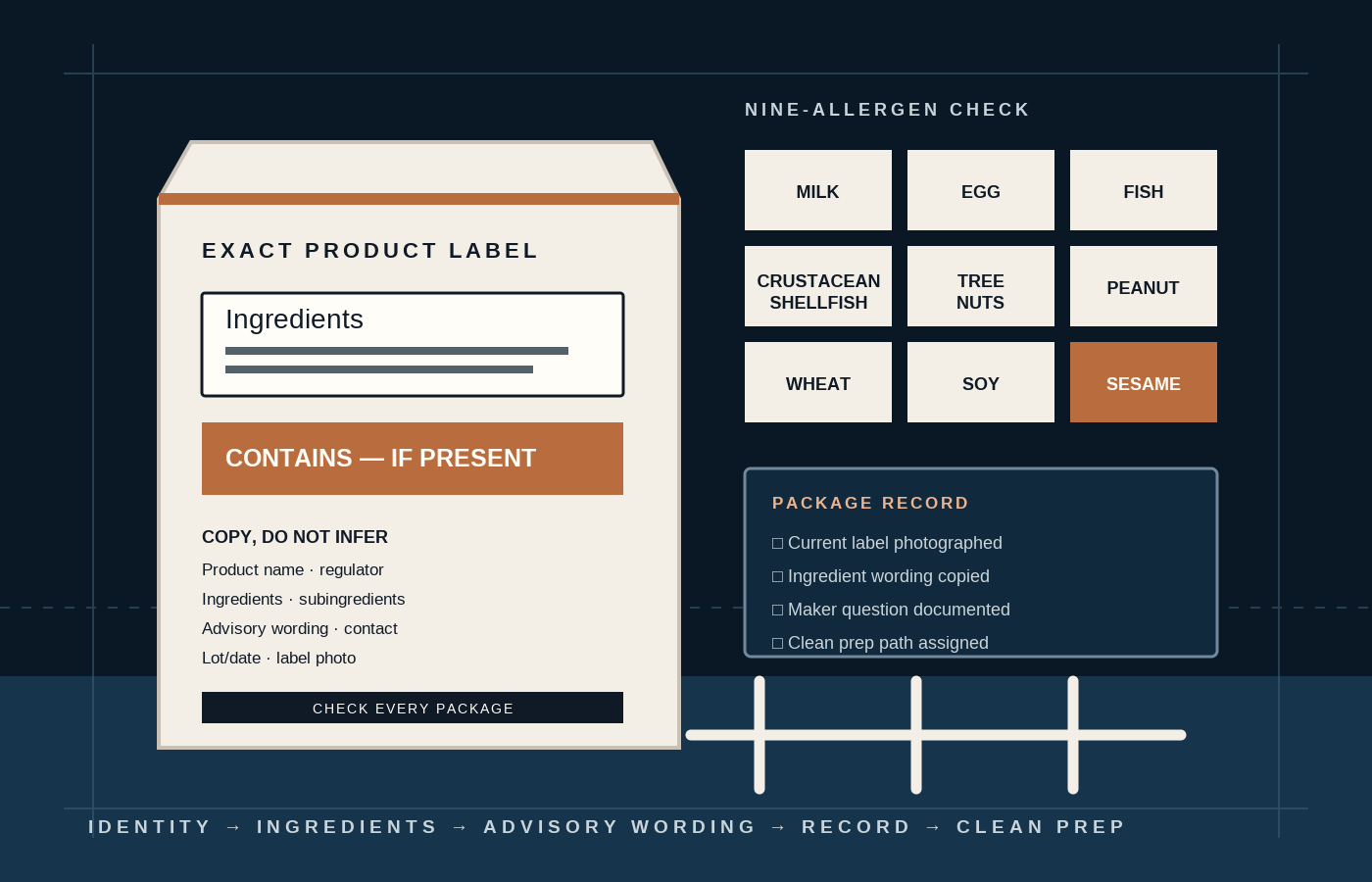
Do not decide whether a freeze-dried meat product fits an allergy plan from the meat photo, the word “plain,” a short online description or the absence of a bold Contains line. Read the complete current package, identify which agency regulates it, and document any unanswered cross-contact question before the food enters the pantry.
Freeze-drying describes water removal. It does not simplify a formulated product into a single ingredient, erase the proteins that matter to an allergy, or make one package interchangeable with another. Beef crumbles may include seasoning; chicken may be prepared with broth; a complete meal may combine meat with dairy, wheat, soy, egg, sesame or another ingredient. Even two sizes bearing a similar front-panel name can have different formulas or manufacturing information.
This is a label-literacy and recordkeeping guide, not a diagnosis or individualized medical plan. A person with a diagnosed food allergy should follow the avoidance and emergency plan from their clinician. If the label or maker cannot answer a question that plan requires, uncertainty is not a green light.
An ingredient statement tells you what was intentionally used in the formulation. A voluntary precaution such as “may contain” addresses possible unintended presence. One cannot substitute for the other, and a missing precautionary statement does not prove a dedicated facility or line.
Use a five-pass label workflow
Pass 1: identify the exact food
Photograph every side of the unopened package. Copy the brand, exact product name, species, cut or form, flavor, net weight, package size, lot or date code and manufacturer or distributor contact. If it is meat or poultry under USDA jurisdiction, photograph the USDA mark of inspection and establishment number. Those identifiers matter if a formula changes or an undeclared-allergen recall is issued.
Keep the front-panel words in perspective. “Beef,” “chicken,” “protein,” “natural,” “simple,” “clean,” and “plain” do not answer the ingredient or cross-contact question. A meal photo is not a formulation. The current physical label is a stronger starting record than a marketplace snippet, cached image or review.
Pass 2: read every ingredient and subingredient
Read the ingredient statement from beginning to end. For USDA-regulated meat and poultry products, FSIS requires ingredients to be declared by common or usual name and generally in descending order of predominance by weight. Multi-ingredient components also need their component ingredients declared, with regulatory exceptions handled under the applicable rules.
Look beyond the meat name. Broth, stock, seasoning, flavoring, sauce, gravy, binder and textured ingredients deserve the same line-by-line reading as the main protein. Copy the wording rather than translating it into a household shortcut. If a compound ingredient or unfamiliar term leaves the relevant allergen source unclear, record the question and use the company contact on that exact package.
Pass 3: locate allergen language—but do not stop there
Federal law recognizes nine major food allergens for FDA-regulated packaged foods: milk, egg, fish, Crustacean shellfish, tree nuts, peanuts, wheat, soybeans and sesame. FDA-regulated labels must identify the food source of a major allergen used as an ingredient, either in the ingredient list or in a nearby Contains statement. Tree nut, fish and Crustacean shellfish declarations identify the specific type.
Meat, poultry and egg products generally fall under USDA FSIS rather than FDA. FSIS states that a separate allergen statement is voluntary on the products it regulates. That makes the complete ingredient statement indispensable: do not assume the absence of a bold Contains box means the product has no allergenic ingredient.
Pass 4: read precautionary wording exactly
Copy any “may contain,” “produced on shared equipment,” or “made in a facility” wording exactly. Do not collapse those phrases into a homemade risk scale. FDA describes advisory labeling as voluntary and says it should be truthful, not misleading and not used in place of good manufacturing practices. A statement's absence does not certify a dedicated line, dedicated room or allergen-free facility.
The important question is whether the package information satisfies the individual's established avoidance plan. If shared-line or facility information matters and the label is silent, ask the current manufacturer. Do not treat a retailer's answer, another flavor's page or an old email as documentation for this product and lot.
Pass 5: record the decision and the date
Mark the package as accepted, rejected or unresolved for the named household constraint. Add the date checked, label-photo location, company response and the exact question answered. Recheck at every purchase. Manufacturers can change formulations, suppliers, labels and production arrangements; a past package record is evidence about that package, not a permanent promise.
First ask: USDA or FDA?
| Label clue | What to inspect | What not to infer |
|---|---|---|
| USDA mark of inspection on a meat or poultry product | Exact product name, full ingredients, voluntary allergen statement if present, establishment number, safe handling and maker contact | That a separate Contains statement is mandatory |
| FDA-regulated packaged food | Ingredient list plus source naming for each major allergen; Contains statement if the maker uses one; advisory language if present | That the Big 9 cover every food a person can react to |
| Composite meal or unfamiliar product | Regulatory markings, complete label and company identity; ask the responsible company when jurisdiction or components are unclear | That the most visible meat ingredient determines every labeling rule |
| Online listing without a readable current label | Request current package images and manufacturer documentation before relying on a dietary claim | That a search filter, badge or old photo is equivalent to the package |
The Big 9 are a federal labeling category, not a complete list of foods capable of causing reactions. FDA notes that more than 160 foods have been reported to cause allergic reactions. A household plan may therefore require attention to ingredients beyond the nine major allergens. “No Big 9 listed” and “safe for this person” are not equivalent claims.
Sesame became the ninth major allergen under the FASTER Act, with FDA requirements effective January 1, 2023. Long-shelf-life foods already in interstate commerce before the effective date were not required to be pulled and relabeled. For an older stored package or unclear wording, use the current FDA guidance and ask the company rather than assuming the age of the pouch settles the question.
Ingredient, advisory and marketing claims answer different questions
Ingredient list
What the maker intentionally used, stated under the rules for that product.
Advisory phrase
Voluntary wording such as “may contain” or shared-equipment language, if used.
“Free-from” wording
A product claim that needs current, product-specific support; never infer it from silence.
Do not use rehydration as an allergen-control step. Adding water changes prepared weight and texture; it does not turn an unsuitable formula into a suitable one. Nor should ordinary cooking, rinsing, draining or picking out visible ingredients be treated as a reliable way to remove an allergen. Choose a compatible product before preparation begins.
Nutrition Facts also cannot replace the ingredient statement. Protein grams, sodium and serving size answer nutrition questions, not whether milk, soy, wheat or sesame was used. Our package-yield guide keeps serving and water math separate; this workflow keeps nutrition, formulation and possible cross-contact separate.
Ask the maker a product-specific question
A useful inquiry begins with exact identity: product name, flavor, size, lot or date code, UPC if present and a photo of the current label. Name the allergen or ingredient in question. Ask whether it is an ingredient or subingredient, whether the current product uses shared equipment, what cleaning or changeover controls the company can describe, and whether the answer applies to this package and lot.
Record who replied, the date, response channel and exact wording. Do not upgrade “we do not add peanuts” into “peanut-free facility.” Do not upgrade “same facility” into “same line,” or a general FAQ into a lot-specific statement. If the representative cannot verify the information, keep the status unresolved.
- Copy package identity. Include exact name, size, flavor, lot/date code and establishment number when present.
- Name one precise concern. Ask about the relevant allergen, ingredient source, equipment or facility—not whether it is broadly “safe.”
- Request current scope. Confirm whether the answer applies to this formulation, package size, facility and lot.
- Save the answer. Store the dated email or call record beside the label photos.
- Apply the household plan. Accept, reject or leave unresolved without inventing a lower risk category.
Public discussions from allergy and preparedness communities repeatedly ask whether base ingredients are easier to vet than complete meals, whether a missing “may contain” phrase settles shared-equipment questions, and whether old online images still apply. Those discussions are useful for finding questions. They are not evidence about a specific pouch; agency rules, the current label, current maker documentation and the individual's clinical plan carry the decision.
Keep the accepted package accepted
Once a package fits the plan, prevent avoidable cross-contact in storage and preparation. Keep it closed, labeled and separated according to the household system. Wash hands and the preparation surface. Use clean, dry utensils and a clean vessel. Do not reach into the pouch with a scoop that touched another food, and do not return unused damp pieces to the dry container.
If cooking is required, follow the package method and the correct food-safety endpoint; cooking state and allergen compatibility are separate decisions. Our preparation-state guide explains how to identify that path. After opening, follow the maker's exact storage window and use the opened-package control so label identity stays attached to the food.
For a shared household, a dedicated bin or clearly assigned tool can make the control visible, but color or location alone does not clean equipment. The operational rule is simple: preserve the package identity, prevent contact with incompatible foods, and follow the person's established plan.
Build a one-package allergen record
Identity · label · decision
- Brand and exact product name
- Flavor, form and package size
- UPC and lot/date code
- USDA establishment number, if present
- Regulator or inspection clue
- Complete ingredients copied
- Subingredients checked
- Contains statement copied, if present
- Advisory wording copied, if present
- Allergen or ingredient being avoided
- Label photos and capture date
- Maker contact and response date
- Exact response wording
- Accepted, rejected or unresolved
- Storage and clean-prep assignment
- Opening date and use-within direction
Keep the record beside the pantry inventory, not inside a private shopping memory. It helps another household member choose the right pouch, preserves the label if the outer package is discarded, and supports an exact match if an undeclared-allergen recall appears. Use the recall match desk to compare product, size, lot, dates and establishment number to an official notice.
Questions at the allergen label desk
Can a single-ingredient meat still require a label check?
Yes. Verify that the product is actually single-ingredient on the current package, then apply the household's cross-contact requirements. A front photo or marketplace title is not enough.
If there is no Contains statement, is the product allergen-free?
No. A separate Contains statement is voluntary on USDA-regulated meat, poultry and egg products. For any product, “allergen-free” is a claim that requires support; silence is not certification.
Does “may contain” mean the allergen is an ingredient?
Not by itself. Ingredients and voluntary precautionary statements answer different questions. Copy both exactly and apply the person's avoidance plan.
Should I trust a product filter or retailer badge?
Use it to narrow a search, not make the final decision. Read the current physical label and obtain current manufacturer information for any unanswered question.
A listing standard for dietary claims
A future Freeze Dried Cuts listing should display readable current images of the exact product name, ingredient statement, allergen wording, Nutrition Facts, preparation state, directions, net weight, lot/date fields, establishment number and manufacturer contact. A dietary filter must point back to the source label and the date verified.
“Allergen-free,” “free from,” “dedicated facility,” “dedicated line,” “single ingredient,” “gluten-free” and shared-equipment claims require current supplier documentation for the exact product. Branded listings, prices, inventory, availability, sellers and checkout remain disabled until supplier authorization and accurate commercial terms, fulfillment, returns and warranties are documented.
Sources
Reviewed November 18, 2026. The current package, responsible agency and manufacturer documentation control the exact product.
- USDA FSIS — Allergen statements on meat, poultry and egg product labels
- USDA FSIS — Ingredient declaration and allergen sensitivity levels
- Electronic Code of Federal Regulations — 9 CFR § 317.2, meat label ingredients
- U.S. Food and Drug Administration — Food Allergies
- FDA — Questions and Answers Regarding Food Allergen Labeling, Edition 5
- FDA — FASTER Act: Sesame Is the Ninth Major Food Allergen
Public discussions were reviewed to identify questions about shared equipment, missing advisory phrases, base proteins versus complete meals and changing online labels. The guidance above relies on current agency sources and exact product records rather than anecdotal assurances.