Field note 006 · Form-fit desk
Ground, diced, shredded or sliced?
Choose the form by the job it must do in the meal—then verify identity, preparation state, ingredients, directions, water and prepared yield on the exact package.
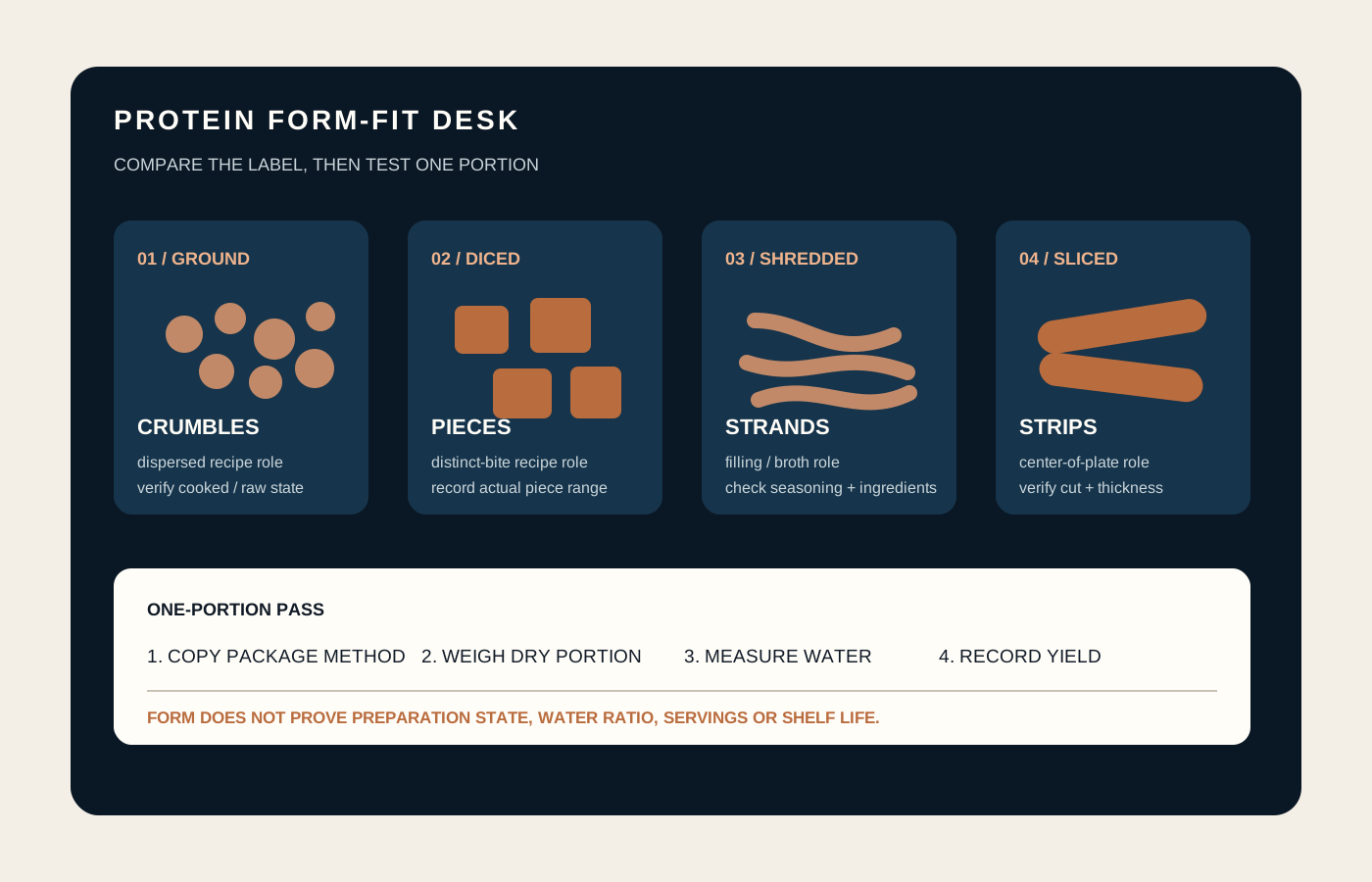
Freeze-dried ground beef is usually the more natural fit for a recipe that needs small pieces throughout a sauce, chili, filling or scramble. Dices, shreds and slices can preserve a more distinct bite. That is a recipe-role decision—not proof of ingredients, preparation state, rehydration time, nutrition, safety or value.
A package labeled “ground,” “crumbles,” “diced,” “shredded,” “strips” or “slices” gives a useful clue about form. It does not finish the comparison. Two products with the same form word can use different species, cuts, fat levels, seasonings, piece dimensions, preparation states, drying processes, serving sizes, water methods and after-opening rules.
Current manufacturer documentation shows the variation. Mountain House describes fully cooked ground beef that can be rehydrated first or added to a sufficiently liquid dish; its own water amounts vary by meat. The same maker publishes separate serving, ingredient and preparation details for diced beef. Those examples demonstrate product-specific methods, not a universal ground-versus-diced rule.
Freeze-dried describes water removal. A ground or diced product can still require cooking. Read for “fully cooked,” “ready-to-eat,” “raw,” “uncooked,” “partially cooked,” “cook before eating,” safe-handling instructions and the complete preparation method. Our preparation-state guide explains the decision path.
Use a form-fit matrix
| Form on label | Useful recipe role to test | Fit questions | Do not assume |
|---|---|---|---|
| Ground or crumbles | Dispersed through chili, sauce, tacos, casseroles, eggs or rice | How fine and uniform are pieces? Does the recipe need drained or retained liquid? | That “ground” means plain, lean, cooked or ready-to-eat |
| Diced or cubes | Distinct pieces in stew, pot pie, pasta, rice bowls or skewered-style dishes | What is the actual piece-size range? Do centers prepare evenly under the package method? | That “diced” names a specific cut, thickness or tenderness |
| Shredded | Fillings, sandwiches, soups, enchiladas or mixed bowls | Are strands long, short, seasoned or clumped? How much liquid remains after preparation? | That shredded meat is unseasoned or interchangeable with pulled meat |
| Sliced or strips | Recipes where the meat remains visible and separate | What are thickness, length, cut identity and trim? Can a thermometer be used if cooking is required? | That “steak,” “slice” or “strip” proves a whole-muscle cut |
| Powder or fine bits | Only uses explicitly supported by the maker, such as a labeled ingredient or seasoning application | Is it meat, stock, extract, flavoring or a multi-ingredient blend? | That a powder is equivalent to a serving of intact meat |
The matrix is deliberately conditional. Texture claims belong to a measured test of the exact product. A larger piece can deliver a distinct bite when fully prepared, but a large or irregular center can also expose an incomplete method. Small pieces may distribute easily while still varying in fat, seasoning and liquid absorption.
Read identity before shape
1. Copy the exact product name
Record species and every form word exactly as printed. “Beef dices,” “ground beef,” “beef crumbles,” “beef-flavored,” “sausage crumbles” and “meat substitute” do not describe the same food. For meat and poultry products, USDA FSIS oversees labeling. If a product carries a USDA mark of inspection, record the establishment number as part of the package identity and recall record.
USDA's standard for raw ground beef distinguishes it from hamburger: ground beef cannot have beef fat added “as such,” while hamburger may; both are capped at 30 percent fat and cannot contain added water, phosphates, binders or extenders under that standard. A freeze-dried product's finished name and ingredient statement still control. Do not use the familiar word “ground” to erase seasoning, processing, added ingredients or a more specific product name.
2. Read the complete ingredient statement
FSIS says ingredients in meat and poultry products are listed by common or usual name in descending order by weight. Copy every ingredient, including seasoning, salt, stock, extracts, oils, sugars and allergens. A short ingredient list is not a guarantee of recipe fit, but it makes the comparison visible.
Keep ingredients separate from the Nutrition Facts panel. The ingredient statement answers what is in the product; Nutrition Facts reports nutrient amounts for the labeled serving. A product with more sodium or saturated fat per serving may behave differently in a recipe even when the visible pieces look similar.
3. Identify the preparation state
Look for a direct statement, not a photo of browned meat. Raw or not-ready-to-eat meat and poultry labels carry handling and cooking signals that must be followed. FSIS requires safe-handling instructions on raw or partially cooked ground meat and poultry products for household consumers. A product that is fully cooked may still have a specific rehydration method and storage instructions.
If cooking is required, complete the package method and use a food thermometer. USDA's consumer guidance sets 160°F for raw ground beef, pork, lamb and veal; 165°F for poultry; and 145°F followed by a 3-minute rest for raw whole beef, pork, lamb and veal steaks, chops and roasts. A product's validated directions may be more specific and control the method. Do not decide doneness by color, texture or the fact that the food is dry.
4. Record actual piece dimensions
Form terms rarely tell the complete size distribution. Pour one dry labeled serving onto a clean tray and record the smallest, typical and largest pieces without tasting. Note fines, broken pieces, clumps and visible seasoning. Photograph the portion beside a ruler and keep it with the label record.
Piece measurements make recipe planning repeatable. A “dice” too large for a narrow-mouth thermos or a strip too long for a compact pouch is a real compatibility issue. So is a very fine crumble that disappears in a recipe intended to have distinct bites.
Keep water, dry weight and prepared yield separate
Form can change how a product occupies a cup, but cup volume is not a reliable proxy for meat mass or protein. FDA explains that Nutrition Facts values refer to the labeled serving size, which is shown in a household measure followed by a metric amount. Compare the grams in that serving, servings per container, calories, protein, total fat, saturated fat and sodium on the current label.
Then copy the package's water amount, temperature, time, stirring and draining directions. Do not transfer a ground-beef ratio to dices or a diced-chicken ratio to shreds. Added water increases prepared mass and volume but does not add protein. Drained water also changes the final measured yield.
Our package-yield worksheet keeps dry net weight, serving size, water and prepared amount in separate fields. Use the rehydration bench when a package is new to the household. A single controlled portion is enough to test recipe fit without exposing the full container.
Dry portion
Measure the labeled household amount and its grams. Record fines and piece-size range.
Package water
Copy volume, temperature, time, stirring, draining and any cooking step.
Prepared portion
Measure total and drained weight, volume, texture, remaining liquid and recipe result.
Run one form-fit test
- Photograph the unopened label. Capture identity, ingredients, Nutrition Facts, preparation state, directions, lot/date code, establishment number, storage and maker contact.
- Check package condition and recalls. Stop for punctures, failed seals, moisture, swelling, leakage or uncertain identity. Use the recall match desk before opening when a notice may apply.
- Measure one dry portion. Use a clean, dry scoop and scale. Record grams, household volume and piece dimensions.
- Follow the exact method. Measure water temperature and volume, start the timer, stir as directed and complete every required cooking step.
- Record prepared yield. Weigh and measure before and after draining when the directions call for it. Keep retained broth separate from meat yield.
- Check the center and texture. Note firm centers, broken pieces, clumping, greasiness and strand or dice integrity. If cooking is required, verify the safe endpoint with a thermometer.
- Test the intended recipe. Use the portion in one representative meal and note whether the form dispersed, stayed distinct, absorbed sauce or displaced other liquid.
- Start the prepared-food clock. Follow the package and current food-safety guidance for prompt use or refrigeration. Never return damp pieces or utensils to the dry container.
- Date the opened package. Follow the maker's product-specific after-opening window; do not apply the unopened shelf life after the seal is broken.
Public discussions repeatedly describe hard centers, chewy ground pieces, missing liquid and texture surprises. Those reports identify questions worth testing. They do not prove a universal defect, water ratio or preparation time. The controlled record shows whether the exact product and recipe pass for your household.
Choose a recipe path before a package size
Liquid-rich recipes
Soup, chili, stew and sauce can sometimes provide the preparation liquid, but only when the exact product directions support adding dry meat and the recipe contains enough measured water. Account for what the protein absorbs so rice, pasta, beans and vegetables are not left short. Complete any cooking requirement.
Low-liquid recipes
Tacos, wraps, eggs, pizza, salads and fried rice usually make a separate one-portion preparation test more informative. Drain only when the directions or recipe call for it. Record whether small crumbles distribute as intended or whether distinct dices and shreds fit better.
Texture-forward recipes
For a stew, bowl or plated dish where the protein remains visible, test the largest typical piece. “Diced” or “steak” in a marketing title does not establish cut identity or tenderness. Ask for exact cut, cooked status, piece-size specification and approved images before treating a product as equivalent to fresh steak.
Dietary and allergen constraints
Read every ingredient and allergen statement each time. Seasoning, stock, soy, dairy, wheat or other ingredients can change recipe fit. Do not infer a product is plain because the front shows only meat, and do not transfer an allergen-free claim from one form or package size to another.
Build a form-fit record card
Identity · method · result
- Brand and exact product name
- Species, cut and form words
- Cooked, ready-to-eat or cook-first state
- Complete ingredient and allergen statement
- Lot/date code and establishment number
- Dry serving: household measure + grams
- Smallest, typical and largest pieces
- Package water, time and temperature
- Required cooking endpoint
- Prepared weight and volume
- Drained liquid, if applicable
- Texture and center observation
- Recipe and number of portions served
- Opening date and use-within date
Keep the card with the pantry inventory. It creates a useful internal link between label literacy, recipe planning and rotation. It also prevents an appealing form name from outranking the product's preparation state or the amount the household can use after opening.
Questions at the form-fit desk
Is freeze-dried ground beef already cooked?
Not as a category rule. Some commercial products are fully cooked; another product can be raw or require further cooking. The exact label and directions decide.
Are beef dices the same as steak?
Not necessarily. Record the exact standardized or descriptive product name, cut identity, ingredients and piece specification. A marketing photo or the word “steak” alone does not establish the cut.
Which form rehydrates fastest?
Do not rank forms without testing the exact products. Piece dimensions, density, fat, ingredients, process, water temperature and method all matter. Follow each package and record one-portion results.
Can I substitute equal cups of ground meat and dices?
Not reliably. Equal dry cup volumes can have different gram weights, serving counts and prepared yields. Compare the label's metric serving and run the recipe with a measured portion.
A listing standard for protein form
A future Freeze Dried Cuts listing should show the exact product name, species, cut or source material, form, piece-size range, preparation state, ingredients, allergens, net weight, Nutrition Facts, dry serving grams, servings per container, maker-stated prepared yield, full preparation directions, after-opening rules, inspection and traceability fields, current label date and approved images.
“Ground,” “diced,” “shredded,” “sliced,” “steak,” “lean,” “single ingredient,” “ready in minutes” and texture claims require current manufacturer support. Branded listings, prices, inventory, availability, sellers and checkout remain disabled until supplier authorization and accurate commercial terms, fulfillment, returns and warranties are documented.
Sources
Reviewed November 5, 2026. The current package and manufacturer directions control the exact product.
- U.S. Government Publishing Office — 9 CFR § 319.15, Miscellaneous beef products
- USDA FSIS — Safe internal temperatures for meat and poultry
- USDA FSIS — Must additives be listed on a product label?
- USDA FSIS — Safe-handling labels for ground products
- U.S. Food and Drug Administration — How to Understand and Use the Nutrition Facts Label
- Mountain House — Cooking With Freeze-Dried Meats
- Mountain House — Diced Beef product documentation
Public discussions were reviewed to identify recurring questions about hard centers, chewy crumbles, direct-to-pot preparation, water ratios and whether “diced” means steak. Comparison and safety guidance above comes from agency sources, current manufacturer documentation and exact package directions rather than anecdotal ratios.